

What is a fractional CFO and why does it matter right now for startups and growth companies? A fractional CFO is a senior finance leader who provides strategic financial leadership on a part-time, contractual, or project basis. Unlike a full-time chief financial officer, a fractional CFO delivers high-impact services—cash flow strategy, fundraising readiness, financial operations, investor reporting—scaled to the company's needs and budget. For founders and CEOs who need sophisticated financial decision-making without the cost and commitment of a permanent hire, a fractional CFO converts uncertainty into a predictable path: clearer runway, faster fundraising, cleaner board reporting, and materially reduced scaling risk.
Transition: before digging into the practical anatomy of this role, clarifying when an outsourced CFO makes the greatest difference helps evaluate fit and expected outcomes.
When a fractional CFO is the right investment
Signs you need a senior financial leader now, not later
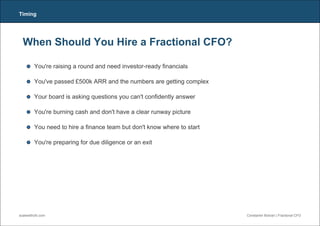
Startups and growth-stage companies typically call in a fractional CFO when the financial challenges outgrow the capabilities of the founder/owner or the controller/bookkeeper. Common triggers:
- Unclear or volatile runway and rising burn without a rigorous forecast.
- Fundraising is imminent or stalled—term sheet negotiations, data room requests, or cap table complexity.
- Rapid scaling with billing, revenue recognition, margins, or unit economics that require strategic oversight.
- Poor quality of financial data, slow month-end close, or weak controls creating operational risk.
- Investor pressure for improved reporting, KPI transparency, or timely board packs.
- Compliance requirements (GAAP accounting, tax, grant reporting) that demand experienced governance.
These are symptomatic of a gap between routine accounting and the strategic finance work that materially affects valuation and survival. A fractional CFO addresses those gaps quickly and with a focus on measurable outcomes.
Who benefits most: buyer personas and practical expectations
Primary audiences that gain disproportionate value from a fractional CFO:
- Founders of pre-seed to Series B firms who need fundraising readiness and runway management without burning equity on a full-time hire.
- CEOs of growth-stage companies managing product-market fit to scale transitions seeking operational discipline and margin improvement.
- Private-equity or strategic acquirers who require interim financial leadership during integration or carve-outs.
- Bootstrapped firms projecting break-even who need cash forecasting and working capital optimization.
Expect what a fractional CFO will do in the first 30–90 days: stabilize cash forecasting, assess internal controls, build or correct the investor deck and data room, establish KPIs aligned to unit economics, and deliver an initial board-ready reporting package.
Engagement models and pricing mechanics
Engagements typically fall into three models:
- Part-time retainer—a fixed monthly fee for defined hours and agreed deliverables.
- Project-based—time-bound engagements for specific milestones (e.g., fundraising, ERP implementation, audit prep).
- Advisory plus success fee/equity—lower cash retainer with performance incentives or equity participation.
Pricing depends on seniority, industry specialization, and scope. Benchmarks: experienced fractional CFOs often charge the equivalent of 20–50% of a full-time CFO's annual cost on an annualized basis when measured by retained hours and deliverables. Transparent scope definition and KPIs are essential to avoid scope creep and to create a predictable ROI.
Transition: now that the engagement context is clear, examine the practical responsibilities and deliverables that produce the outcomes founders actually care about.
Core responsibilities and the deliverables that matter
Cash flow management and forecasting
Cash is the single most important metric for early-stage companies. A fractional CFO establishes a repeatable and stress-tested cash flow forecast with scenarios tied to specific operational levers: hiring, marketing spend, pricing changes, and collections discipline.
Key practices:
- Build a rolling 13–26-week forecast linked to bank balances, AR/AP cadence, and committed cash items.
- Create scenario models—best case, base case, worst case—mapping actions to runway days saved or lost.
- Introduce cash KPIs: days payable outstanding (DPO), days sales outstanding (DSO), and cash conversion cycle.
- Implement simple tools (spreadsheets with live connections or lightweight FP&A software) and ensure weekly manager-level reviews.
Result: management gains runway visibility that supports disciplined decision-making and reduces reactive fundraising or layoffs.
Financial planning & analysis (FP&A), metrics, and unit economics
Beyond cash, the fractional CFO defines the structure of financial intelligence: the KPIs that drive growth and margins. For a SaaS startup this includes MRR/ARR, churn, CAC payback, LTV, gross margin, and cohort analysis. For marketplaces or transactional businesses it includes take rate, contribution margin, and supply-side metrics.
Deliverables and processes:
- Monthly management reporting with variance analysis and narrative explaining the levers behind changes.
- Unit economics model and sensitivity tables used in pricing and go-to-market decisions.
- Operational dashboards for sales, marketing, and product leaders to align objectives and budgets.
Outcome: clearer causal links between investments and results, enabling faster iteration and fewer wasted bets.
Fundraising readiness and capital strategy
Preparing for fundraising is technical and procedural. A fractional CFO coordinates the financial side of diligence and positions the company to negotiate better terms.
Core actions:
- Clean and standardized historical financials prepared under GAAP or adjusted metrics where appropriate; reconcile bookings vs revenue recognition.
- Build an investor-ready financial model that validates the go-to-market plan and shows clear levered growth scenarios.
- Organize the data room: cap table, capitalization schedule, governance documents, contract templates, customer metrics, legal and tax filings.
- Prepare the financial narrative and answers for common VC diligence questions: unit economics, churn drivers, cohort retention curves, payback periods.
Impact: shorter fundraising cycles, fewer surprises in diligence, and stronger negotiating positions that protect valuation and control.
Financial operations, systems, and internal controls
Operational weaknesses—late closes, poor AR/AP processes, uncontrolled spend—create hidden costs and risk. A fractional CFO implements practical controls and scalable systems without creating bureaucracy.
Typical improvements:
- Implement or optimize ERP/accounting stack: chart of accounts, automated reconciliations, and role-based access.
- Standardize approval workflows for hiring and capital expenditure.
- Implement a month-end close checklist and reduce close time to actionable windows for leadership.
- Design lightweight compliance practices for tax, payroll, and grant or contract obligations.
Result: reduced error rates, faster financial insight, and lower audit risk. For companies heading to Series A/B, these improvements also meet investor expectations for governance.
Board reporting, investor relations, and governance
Transparent, crisp reporting to investors and boards changes the tone of relationships. A fractional CFO crafts an integrated board pack that balances data with strategic narrative.
Essentials:
- Monthly or quarterly board packs with trend analysis, KPI commentary, and decision-focused asks.
- Investor communication cadence—updates that preempt concerns and signal competence.
- Support for board meetings: materials, rehearsals, and follow-ups that track action items.
Outcome: stronger investor trust, fewer surprise requests, and the ability to use the board as a resource rather than a firefight source.
Transition: with responsibilities defined, the next section explains how these activities translate into measurable outcomes that founders can quantify.
How a fractional CFO produces measurable business outcomes
Improving runway visibility and optimizing burn
Runway is not just "how many months left"—it's a dynamic measure that reflects decisions. A fractional CFO converts arbitrary forecasts into actionable dashboards tied to levers:
- Hiring freeze thresholds and prioritized hiring plans with impact on burn.
- Marketing ROI thresholds that identify channels to pause or scale.
- Receivables acceleration tactics and vendor negotiation to extend runway without layoffs.
Measured impact: more precise runway estimates (confidence intervals replacing single-point guesses), actionable conservations that save cash, and avoidance of forced, value-destructive fundraising.
Faster fundraising and improved valuation outcomes
VC diligence focuses on credibility: clean numbers, repeatable growth, and defensible unit economics. A fractional CFO reduces the time-to-close by delivering:
- Investor-grade financial models with scenario sensitivity and clear assumptions.
- Organized data rooms that minimize DD back-and-forth.
- Negotiation support: term sheet financial implications, pro forma cap tables, and dilution modeling.
Result: shorter sale cycles, higher probability of term sheets, and an ability to choose investors rather than accept a single offer under pressure.
Lower financial and operational risk during scaling
Operational breakdowns scale with revenue and headcount. A fractional CFO institutes guardrails that reduce risk exposure:
- Segregation of duties in finance processes to prevent fraud and errors.
- Forecasting and covenant management to avoid covenant breaches on debt facilities.
- Tax and compliance readiness to avoid back taxes, penalties, or onerous restatements.
Measured impact: fewer surprises, preserved valuation, and a smoother path to audits or acquisition diligence.
Operational scaling and margin expansion
Strategic finance work produces margin improvement by focusing on the unit economics and operational levers:
- Pricing optimization that increases average revenue per user or margin capture.
- Cost-to-serve analysis identifying lower-value segments or expensive fulfillment flows.
- Capital allocation frameworks to prioritize high-ROI investments.
Outcome: improved gross margins and contribution margins that scale with topline growth—key signals for later-stage investors.
Transition: achieving those outcomes depends on choosing the right fractional CFO and structuring the engagement correctly. Next, fractional cfo service tiers on selection, contracting, and onboarding.
Selecting, engaging, and integrating a fractional CFO
Hiring criteria and the right interview questions
Hiring the wrong senior finance leader wastes time and cash. Prioritize:
- Relevant domain experience—SaaS, marketplaces, hardware, or enterprise B2B—because metrics and capital needs differ.
- Track record with startups at your stage and with similar fundraising outcomes.
- Technical competence across FP&A, GAAP, revenue recognition, and cash forecasting.
- Soft skills: partner with the founder, translate finance to business language, and manage investors.
Interview questions to surface fit:
- Describe a time you extended runway without raising capital. What actions and trade-offs did you take?
- Explain how you built an investor-ready model and what assumptions were hardest to validate.
- How have you structured monthly board reporting and which KPIs did you insist on?
- Describe a systems migration you led and how you ensured minimal disruption.
Contract structure, KPIs, SLAs, and confidentiality
Good contracts are outcome-oriented. Include:
- Scope of work and frequency of deliverables (weekly cash update, monthly board pack, fundraising support).
- Performance KPIs—runway accuracy, time-to-close on fundraising, reduction in close cycle time, or month-end close targets.
- Service level expectations (response times, availability for board calls) and escalation paths.
- Confidentiality, data security requirements, and any conflict-of-interest clauses if the CFO works with competitors.
Consider a phased approach: a 90-day initiation phase with defined deliverables, followed by rolling monthly retainers tied to outcomes.
Onboarding and the first 90 days roadmap
An effective first 90 days follow a predictable agenda:
- Week 1–2: Stabilize cash position and access systems. Build a one-pager of current financial health and critical risks.
- Week 3–6: Deliver a clean month close, build the initial 13-week cash forecast, and set KPIs with leadership.
- Week 6–12: Prepare fundraising materials or operational improvements, implement process fixes, and produce the first board pack.
Outcomes to measure at 90 days: accurate weekly cash forecast in place, a shortened close cycle, and a clear fundraising plan or capital strategy.
Measuring ROI and continuing the relationship
ROI should be quantified: runway extended, fundraising timelines shortened, better negotiated terms, or cost savings from process improvements. Track:
- Pre- and post-engagement runway and burn.
- Time-to-close and valuation delta versus comparable rounds.
- Operational metrics: close time, error rates, and time to retrieve key reports.
Regular reviews—monthly or quarterly—ensure the engagement evolves from tactical fixes to strategic partnership.
Transition: cost is always a constraint. The next section compares fractional CFO costs and benefits with full-time hiring and other advisory options.
Cost, trade-offs, and when to go full-time
Direct and hidden costs compared
Compare typical costs:
- Full-time CFO: salary, benefits, equity dilution, recruiting costs, and ramp time. A credible experienced CFO can cost materially more than early-stage budgets allow.
- Fractional CFO: lower fixed cost, faster ramp, flexible exit. Paid for outcomes rather than overhead.
- Consulting firm or boutique: breadth of services but potential misalignment and higher hourly rates.
Hidden costs to consider: decision-making latency with part-time availability, potential lack of deep context if the fractional CFO serves multiple clients, and the need for a strong controller or head of accounting to execute daily tasks.
When to transition to a full-time CFO
Signal points for full-time hire:
- The company has predictable revenue growth ≥$15M ARR or complex capital structures requiring daily attention.
- Multiple concurrent strategic initiatives needing full-time financial leadership (M&A, international expansion, IPO readiness).
- Investor expectations or governance that demand a full-time C-suite presence.
Until these conditions are met, a fractional CFO often delivers better capital efficiency and preserves runway.

Working with finance teams and other advisors
Best outcomes come from complementary roles: a solid controller or outsourced accounting provider plus a fractional CFO. The controller maintains transactional accuracy; the fractional CFO converts accuracy into strategy.
When working with external auditors, law firms, or bankers, a fractional CFO should coordinate these relationships to ensure consistent messaging and reduce duplication.
Transition: to make the discussion concrete, the following includes compact case scenarios and practical templates you can adapt immediately.
Concrete examples and tactical templates
SaaS startup: recovering runway and improving fundraising odds
Situation: $1.5M in ARR, monthly burn of $250k, 6 months of naive runway, churn creeping up.
Fractional CFO actions:
- Built a 13-week cash model and identified a $50k monthly savings by pausing low-ROI campaigns and deferring nonessential hires.
- Improved churn reporting: implemented cohort analysis and recommended product improvements tied to retention targets.
- Prepared an investor-ready model and data room; shortened fundraising time from 16 to 7 weeks and negotiated a term sheet with less dilution.
Outcome: runway extended to 9 months without an immediate raise, and a successful round at a higher pre-money valuation.
Marketplace scaling to Series B: unit economics clarity
Situation: Rapid top-line growth but negative gross margins on new customers and incomplete revenue recognition.
Fractional CFO actions:
- Modeled take-rate sensitivity and recommended pricing and fee structures to convert contribution margin positive.
- Implemented revised revenue recognition procedures and standardized billing contracts.
- Built quarterly investor dashboards highlighting margin expansion and adjusted CAC calculations.
Outcome: improved unit economics demonstrated to investors resulted in a successful Series B raise and a path to adjusted EBITDA positive.
Operational templates you can adapt
Mini-templates to copy:
- 13-week cash forecast: bank balance, cash-in by source (sales, collections, draws), cash-out by category (payroll, vendors, capex), and weekly ending balance with scenario toggles.
- Board pack outline: executive summary, KPI dashboard with trend lines, cash and runway analysis, variance analysis, strategic initiatives and asks, risk register.
- Fundraising readiness checklist: historical financials (3 years or since inception), cap table and option pool, revenue recognition memo, material contracts, employee equity docs.
Transition: fractional CFOs are powerful, but they are not a silver bullet. The next section identifies common limitations and governance considerations.
Risks, limitations, and governance safeguards
When a fractional CFO may not be enough
Limitations include:
- Intensity of need: during M&A integration or IPO preparation, full-time, dedicated leadership may be required.
- Operational bandwidth: if finance is deeply fragmented, a fractional CFO can advise but execution will still require competent accounting resources.
- Availability constraints: part-time availability can slow urgent decisions, which requires clear escalation rules.
Conflict of interest, confidentiality, and compliance
Risks to manage:
- Ensure the fractional CFO signs robust non-disclosure and non-solicit agreements and discloses any potential conflicts if they serve competitors.
- Confirm cybersecurity and access controls for financial systems and sensitive investor data.
- Document decision authority limits to avoid governance ambiguities.
Data quality, systems dependency, and capacity building
A fractional CFO cannot fix data that does not exist. Invest in:
- Reliable accounting processes and a controller or outsourced provider to execute timely, accurate books.
- Basic systems integration (bank feeds, billing, CRM-to-finance data flows) so the CFO's models reflect reality.
- Knowledge transfer plans so improvements persist if the fractional CFO departs.
These safeguards protect the investment and ensure that strategic gains are durable.
Transition: to close, summarize the core value proposition and give clear next steps founders can take immediately.
Summary and actionable next steps
Fractional CFOs provide focused, senior financial leadership tailored to the stage and needs of startups and growth companies. They bridge the gap between accounting and strategic finance, producing tangible benefits: improved runway visibility, faster fundraising readiness, cleaner board reporting, and reduced scaling risk. The model is cost-effective, outcome-oriented, and scalable—especially when paired with strong accounting execution and clear contractual KPIs.
Actionable next steps you can take today:
- Run a quick diagnostic: build a one-page health check with current cash balance, burn rate, runway, top three financial risks, and the nearest financing event.
- If the diagnostic shows short or unclear runway, engage a fractional CFO for a 30–90 day stabilization sprint focused on cash and fundraising readiness.
- Define measurable KPIs for any engagement: runway days added, fundraising time reduction, month-end close time, or margin improvement targets.
- Ensure you have an accounting partner (internal controller or outsourced provider) to execute daily finance operations so the fractional CFO can focus on strategy.
- Create a three-month onboarding checklist: system access, historical financial pack, a prioritized list of fixes, and the dates for the first board pack and cash forecast delivery.
These steps move finance from reactive to strategic and make the next financing or scaling milestone achievable with greater confidence and less dilution.